
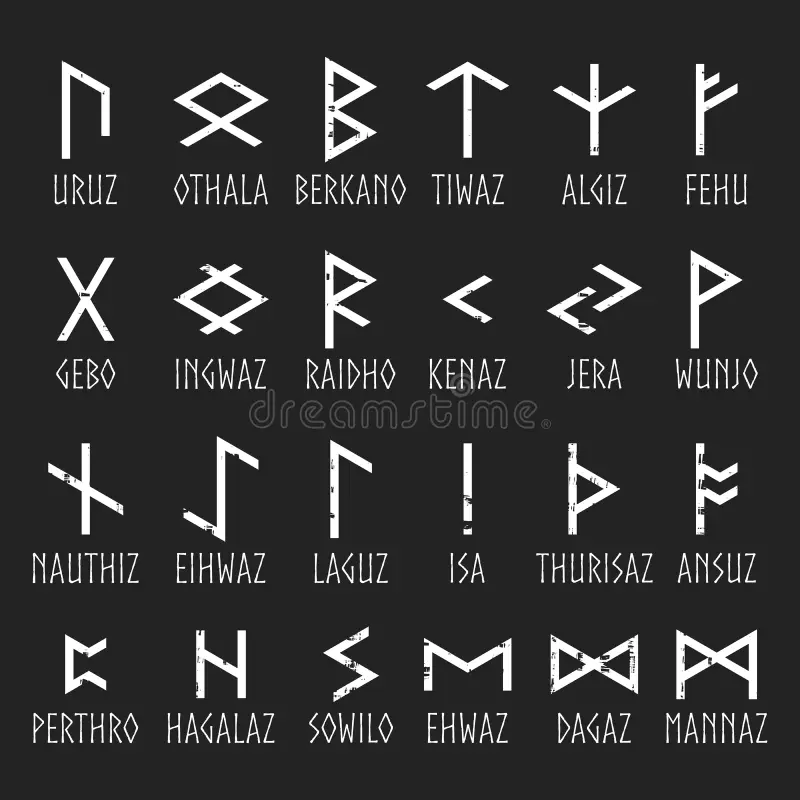
Writing your name in Elder Futhark runes is not just a fun activity — it is a way to connect with the culture, language, and beliefs of the ancient Germanic peoples. The Elder Futhark is the oldest form of the runic alphabet, used roughly between the 2nd and 8th centuries CE, primarily by early Scandinavians and other Germanic tribes.
Runes were more than just letters. They were symbols of power, each carrying its own name, sound, and sometimes even magical or spiritual meaning. In ancient times, runes could be carved on weapons, stones, jewelry, and wooden artifacts to record messages, commemorate events, or invoke protection.
Step 1: Break Your Name into Sounds
Unlike our modern alphabet, runes represent sounds (phonemes), not individual letters. This means that before you can translate your name, you must break it down into its basic sounds. For example, the English name “Charles” can be broken into CH – AR – L – S.
- “A” can be represented by Ansuz
- “B” can be represented by Berkano
- “Th” can be represented by Thurisaz
- “M” can be represented by Mannaz
Step 2: Match Each Sound to a Rune
Once you have the sounds, use a Rune Alphabet Chart to find the correct symbols. Some modern letters do not have a direct rune equivalent, so you’ll need to choose the closest sound. For example, the letter “C” may be replaced with “K” or “S” depending on its pronunciation in your name.
Step 3: Arrange Runes in Order
Historically, runes could be written left-to-right, right-to-left, or even in a spiral pattern on stones. For modern purposes, writing left-to-right is most common. Make sure each rune is clear and proportionate.
Step 4: Add Decorative or Magical Elements
In Viking culture, runes were often carved with additional symbols or dots to separate words. Some inscriptions included bind runes — two or more runes merged into one symbol — which were believed to enhance magical effects.
Example: Translating "Emma"
Breaking it into sounds: E – M – M – A
- E → Ehwaz
- M → Mannaz
- M → Mannaz
- A → Ansuz
The Elder Futhark version of “Emma” would be represented using the runes for Ehwaz, Mannaz, Mannaz, and Ansuz.
For a quick conversion, try our Rune Keyboard Tool, which lets you type your name and instantly see it in runes.
Final Tips
- Remember that runes are phonetic — focus on sound, not spelling.
- Not all modern names have a perfect rune equivalent, so use your best judgment.
- If you are engraving runes, keep lines sharp and deep for visibility.
By learning to write your name in runes, you’re not only creating a unique personal inscription but also reviving an ancient tradition that connects us to the mysterious world of the Vikings and their ancestors.